

Innovation House at BHS is designed to prepare students for the future.
In 2014, BHS embarked on a pioneering journey in launching its “Leading the Way” capital campaign, which raised $11.5 million for the construction of an Innovation Centre to house a STEAM-based (science, technology, engineering, arts and math) curriculum. A further $500,000 is being raised for additional furnishing, fittings, and equipment.
The new facility, which is on target to open for the upcoming school year, is a two-storey 14,000-square-foot structure with an array of modern learning spaces and technology. The new building
also connects to the school’s adjacent Butterfield Building, which has been extensively renovated to house new music, art, drama, and math areas.
“It has been a long but rewarding journey to get to this point,” says Linda Parker, head of school at BHS. “With the immense challenges over the last few months due to the pandemic, we definitely wondered if we would be able to complete the project for the start of the 2020/2021 academic year.”
Perhaps the most intriguing aspect of the building is the convergence of the disciplines needed to build it and the subjects that will be learned within it.
“I think BHS should be commended for realising and fulfilling the goal of building an educational facility that was specifically designed to facilitate a STEAM curriculum and approach to learning – one that I believe in,” says Gary Simmons, partner at Linberg & Simmons, the architectural firm for the project.
As an all-girls school (through year 12), BHS has a particular commitment to ensuring girls are prepared to take leadership positions in Bermuda and around the globe. The Innovation Centre is the first of its kind in Bermuda, which Mrs. Parker says is “an enormous leap forward for BHS.”
“We have a responsibility to prepare our girls for the jobs of today as well as to anticipate future trends,” she says. “A strong STEAM education meets this challenge.” The design of the building not only supports the goals of this curriculum but also reflects the principles of the school itself.

“An important part of the design process was to explore the ideas of expressing ‘Purity and Strength’ (the school motto) in the built structure,” says Germano Botelho, chairman of the Buildings and Ground Committee and co-chair of the STEAM taskforce at BHS and an architect by profession. “This has been achieved, for example, by not hiding some of the structure elements, leaving steel beams exposed and polishing the concrete floors to a finished product.” Mr. Simmons adds that, “Deliberately exposing crude parts of the structure and systems in a playful and aesthetically interesting manner allows that the structure and systems can become tools for learning.”
This learning process has been going on throughout the design and construction of the facility. The school has also sought feedback and input from students on both the design of some of the spaces and the furnishings within.
“Over the last four years, students have been working with Linberg & Simmons and Botelho Wood Architects during our annual STEAM Weeks, gaining experience and an understanding of architecture and design,” says Catherine Hollingsworth, head of secondary at BHS. “One year, nine student spotted an issue (in one of the bathrooms) with the hand dryer being placed on the opposite side of the entrance to the sinks and thus causing the potential for the floor to become wet and slippery.

“It has also been essential to work closely with the specialist teachers throughout the design of the spaces and selection of the furniture.” The students have also been proactive in raising money for the installation of solar panels, the structure for which is in place, and they will be installed over time. “The students are always keen to ensure the school is as eco-friendly as possible,” says Ms. Hollingsworth. Of course, a state-of-the-art STEAM Centre must feature technology to support the learning, which Mr. Botelho says required a lot of coordination, miles of cable and significant resources. The result is seamless, and largely hidden, connectivity throughout the facility and out into the world. Interestingly, Mr. Botelho notes that there is an age-old piece of technology connecting the spaces and serving the collaborative learning environment. “The most interesting technology used in the building, and in between classrooms, is one of the simplest – glass,” he says. “We used glass to connect between classrooms and corridors. Glass connects the old buildings with the new and the exterior with the interior. Teaching and learning are on display everywhere you turn.”
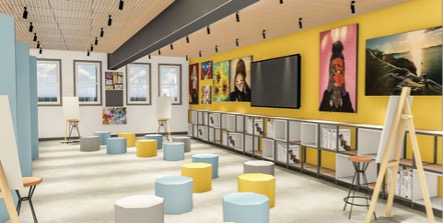
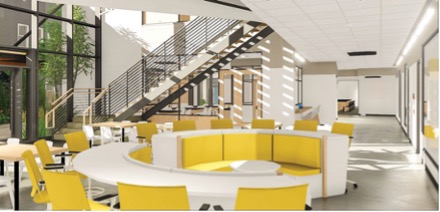
And that teaching and learning will extend beyond BHS and into the wider community. “From the very beginning of this project, we were adamant that girls across Bermuda should benefit from our facility,” says Mrs. Parker. “The building will house a purpose-built leadership centre that will provide new opportunities for partnerships between the public and private schools.”
With the tremendous upheaval caused by COVID-19 at the end of the previous school year, there is, understandably, great anticipation for the new year and new building at BHS. “I feel immensely proud of all the work that has taken place to get us here and to everyone who has been
a part of that process,” says Mrs. Parker. “In my mind, I can see the students in the reading nooks, I can hear the machines in the MakerSpace, and I can feel the excitement of the students discovering science through experiments in the labs. “Students will be inspired to dream and imagine, explore their sense of curiosity, showcase their talents and hone their skills, and prepare for the remainder of the 21st century and beyond.”